


Authors
Abstract
In patients with compensated alcohol-related cirrhosis, reliable prognostic biomarkers are lacking. Keratin-18 and hepatocyte-derived large extracellular vesicles (lEVs) concentrations reflect disease activity, but their ability to predict liver-related events is unknown.
Methods: We measured plasma keratin-18 and hepatocyte lEVs concentrations in 500 patients with Child-Pugh class A alcohol-related cirrhosis. Ability of these hepatocyte-derived biomarkers, alone or combined with MELD and FibroTest, to predict liver-related events at 2 years was analyzed, taking into account the alcohol consumption at inclusion and during the follow-up.
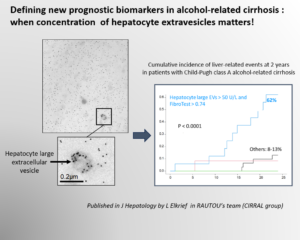
Results: Keratin-18 and hepatocyte lEVs concentrations increased with alcohol consumption. In patients without active alcohol consumption at enrollment (n=419), keratin-18 concentration predicted liver-related events at 2 years, independently of FibroTest and MELD. Patients with both keratin-18 concentration >285 U/L and FibroTest >0.74 had a 24% cumulative incidence of liver-related events at 2 years, versus 5% to 14% in other groups of patients. Similar results were obtained when combining keratin-18 concentration >285 U/L with MELD >10. In patients with active alcohol consumption at enrollment (n=81), hepatocyte lEVs predicted liver-related events at 2 years, independently of FibroTest and MELD. Patients with both hepatocyte lEVs concentration >50 U/L and FibroTest>0.74 had a 62% cumulative incidence of liver-related events at 2 years, versus 8% to 13% in other groups of patients. Combining hepatocyte lEVs concentration >50 U/L with MELD >10 had a lower discrimination ability. Similar results were obtained using as endpoint decompensation of cirrhosis defined according Baveno VII criteria.
Conclusion: In patients with Child-Pugh class A alcohol-related cirrhosis, combining hepatocyte-derived biomarkers with FibroTest or MELD score identifies patients at high-risk of liver-related events, and could be used for risk stratification and patient selection in clinical trials.